The Amazon guide to reaching high-value shoppers



The story of the year is that targeting on Amazon is becoming much more custom.
Between Brand Tailored Promotions and bid boosting, it’s now possible to market your products differently—through discounts or ads—to different groups of shoppers.
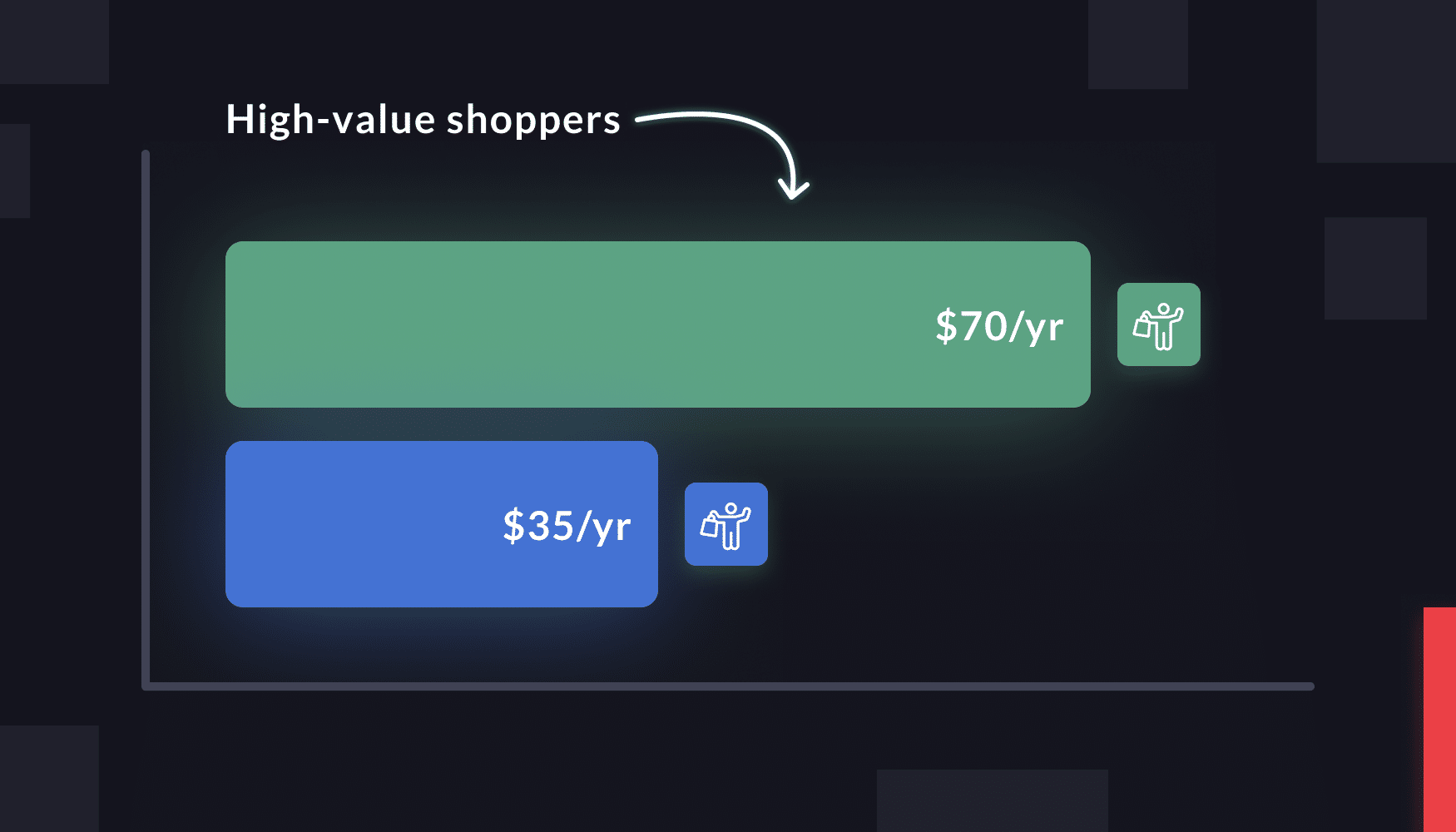
Nowhere is this more apparent than when we’re talking about “high-value shoppers,” meaning the cohort of people who spend a lot on your brand (or are projected to spend a lot on your brand).
Any Amazon brand can now advertise—or discount—differently to people who they know are likely to spend a lot on them in the long run.
This allows savvy advertisers to make much smarter budgeting decisions, and spend extra ad dollars on shoppers who they know will drive a big return.
How do you create an audience of high-value shoppers?
The process of targeting high-value shoppers differs depending on whether we’re discussing ad campaigns or targeted discounts.
Brand Tailored Promotions, for instance, relies on an audience of high-value shoppers that is pre-built by Amazon.
You don’t have to do any work to generate that audience yourself—but you’re also, of course, limited to Amazon’s definition of high-value shoppers.
By contrast, when you want to run targeted ads, you have to create this high-value shopper audience yourself.
Creating your own high-value advertising audience is only possible in Amazon Marketing Cloud. AMC can tie all of the purchases of your products to the relevant shoppers, letting you see which shoppers are repeat buyers and the average price of what they buy.
Sum all of that up, and you can easily separate out the high-value shoppers—usually the top 5% or 10% of spenders—from the rest of the group.
For what it’s worth, the Intentwise Explore query and audience library has built-in, pre-written queries and audiences for high-value shoppers. You can customize them, and schedule them to run in the background, with a single click.
The downside of creating your own high-value audience in AMC is that if you want to get a full view of your high-value shoppers, you’re going to need to count organic purchases. And therefore, you’re going to need to buy a subscription.
A truly high-value shopper is someone who repeats purchases or buys an upsell without the intervention of an ad. In AMC, accessing organic, non-ad-attributed data requires the Shopping Insights subscription from AMC’s Paid Features.
But good news: As of this month, audience creation using Shopping Insights is going to be free—forever.
(Read more about that AMC Shopping Insights subscription here.)
What can you do with high-value shoppers on Amazon?
The beauty of segmenting out high-value shoppers is that it makes your advertising decisions more sophisticated.
With a high-value shopper audience at your fingertips, you can benefit from:
Smarter spending allocation. If you know someone is a high-value shopper, they are probably very likely to buy more products from you in the future.
So it’s well worth spending extra money on ads to convert them, as compared to the typical shopper.
Bid boosting in AMC becomes especially useful in this context. With bid boosting, you can attach an audience that you custom-create in AMC to any of your ad campaigns.
In AMC, you can build an audience of shoppers who are already big spenders of your brand—or, alternately, an audience that looks a lot like this high-value cohort.
From there, bid boosting is simple: Just attach that audience to your Sponsored Products or Sponsored Brands campaigns, and you can automatically bid higher whenever someone from that cohort sees your ads.
(For more on the mechanics—and limits—of bid boosting in AMC, read our whitepaper here.)
Direct targeting. Specifically for Sponsored Display and DSP ads, you can now directly target high-value shoppers.
In the process, you can run ad creatives that speak directly to your high-value shopper audience.
This opens up all sorts of possibilities: Maybe you want to push an upsell product on them, or you want to hype up the high quality of your brand to build more loyalty.
Creative analysis. As we mentioned, AMC maps out every single one of your shopper journeys, and then lets you aggregate them at scale.
That means, once you’ve segmented out a cohort of high-value customers, you can look back at how they came to your brand in order to make additional connections.
Is there a particular ASIN, or set of ASINs, that brought a disproportionate share of high-value shoppers into the fold? Then you might consider boosting your advertising for that ASIN in order to draw in these valuable shoppers.
Tailor your deals to high-value shoppers on Amazon
As of yet, Amazon doesn’t let you change the price or description of a product based on the shopper who stumbles on it. But through Brand Tailored Promotions, you can offer discounts to high-value shoppers.
These shoppers won’t be notified of your deal, but if they stumble on your product page or see the product in search results, they’ll see your discount.
It’s a way of drawing in a coveted audience.
Of course, that might not be appealing. After all, you already know they’re going to be high spenders—why give your biggest spenders a discount upfront?
The truth is, the best strategy really varies based on the context. Depending on your profit margin and repeat purchase rate, it might be well worth offering an upfront discount to someone you know is going to be a big spender.
If your product has a high repeat purchase rate, the way a supplement does, then you know that taking a small loss upfront is sure to pay for itself. The real issue is getting the shopper in the door—once they buy from you once, they’ll probably keep buying from you.
If you have a slim profit margin and/or repeat purchase rate, the calculus is likely to be different.
Are there any downsides of targeting high-value shoppers?
The category of “high-value shoppers” is inevitably based on past data.
If you’re only going after people who already spend a lot on your brand, or who simply behave similarly to people who spend a lot on your brand, then you’re still ultimately just doubling down on one type of shopper.
High-value shoppers are a key category for deciding how to allocate money, but exclusively going after that group isn’t going to necessarily grow your business that much.
The work of a savvy advertiser, of course, is to always find new kinds of shoppers to reach—through better targeting, different product types, and so on.
Meaning: Shoppers you don’t yet know are going to be valuable to you.
High-value shopper targeting is a tool to have in your toolkit, but it shouldn’t be your end-all-be-all.